
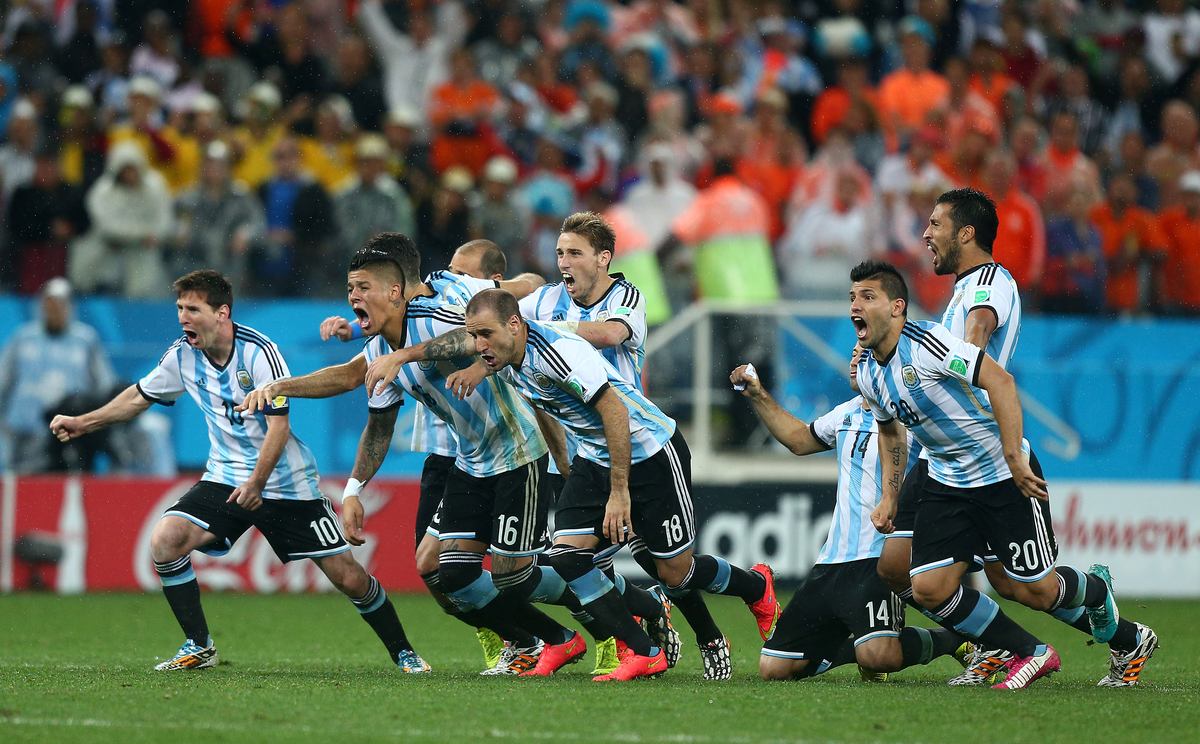
Lionel Messi and company couldn’t quite cap off a perfect year for Argentine football but beaten finalists in football’s showcase event, in addition to the nation providing the Copa Libertadores and Copa Sudamericana winners, it was a positive 2014 all in all. The on-field triumphs were matched or perhaps even trumped in terms of their significance by the death of Don Julio Grondona, who has managed to continue to meddle in Argentine domestic matters from beyond the grave and so with 2015 already upon us, we take a quick look back over a dramatic 2014 in Argentina.
It would be odd to start anywhere other than the World Cup in Brazil where Alejandro Sabella ended Argentina’s 24-year-wait to reach the Semi Finals of the world cup. A slow start saw La Albiceleste ease through to the knockout stages but fail to impress from their relatively straight forward group and it was not until the quarter final victory over Belgium that the nation became truly gripped.
The drama of the penalty shootout win over the Netherlands in the semi final was the definitive moment of the tournament for Argentina and the ensuing celebrations in Buenos Aires were an indication of the relief that Argentina had returned to the pinnacle of world football.
Ultimately, of course, Mario Götze’s late winner deprived the heroic Javier Masherano and his troops the opportunity to lift the famous trophy but the team left Brazil with their pride intact and only a sense of what might have been, given the injuries to Ángel Di María and Sergio Agüero.
Alejandro Sabella then opted to step down as the manager and the AFA replaced him with former Barcelona coach, Gerardo Martino. The remainder of the year has seen Tata experiment a little as he still seeks his preferred style and personnel. The recall of Carlos Tevez has been the main talking point but 2015 brings the real test as the Copa América in Chile lies ahead.
The World Cup may have been a disappointment for captain Lionel Messi but it has been a record breaking year with Barcelona for the four-time Ballon D’or winner. In the space of a week in Novemeber, Messi finally surpassed Telmo Zarra’s 59-year-old La Liga goal scoring record and then with a hat-trick against APOEL Nicosia he moved ahead of Raúl as the Champions League’s leading marksman. Still only 27 years of age, the records will continue to tumble for Messi and one hopes that 2015 can see him lead Argentina to Copa América glory.

Where Argentina fell at the final hurdle, the nation’s club sides enjoyed a year of continential dominance. In August, San Lorenzo captured their maiden Copa Libertadores, ending years of city sneering from their rivals. Néstor Ortigoza’s penalty in the second leg in Bajo Flores ensured that El Ciclón celebrated the greatest moment in the club’s history.
Just before 2014 came to an end, Edgardo Bauza’s side had the chance to go one better and win the Club World Cup but the galacticos of Real Madrid ended that particular dream with a comfortable victory in Marrakesh. Even in light of the defeat, it has been a triumphant year for San Lorenzo with the return to their rightful home in Boedo finally confirmed.
River Plate saw 2014 as the year that they well and truly reclaimed their place back at the top table after the misery of relegation in 2011. Ramón Díaz oversaw the start of this process when River celebrated lifting the Torneo Final in May but the momentum was well and truly maintained when Marcelo Gallardo stepped into the hotseat in the aftermath.
The 38-year-old managed to improve the Torneo Final champions and perhaps had it not been for the injury to exciting youngster Matías Kranevitter and undoubtedly the strain with competing in two competitions, we might have been looking back on River bicampeones.
As it is we still look back on an incredibly successful year for River. Gallardo’s side ended the 17-year-wait for international glory when they defeated Atlético Nacional to win the Copa Sudamericana, beating arch rivals Boca Juniors on the way just to make it even sweeter.
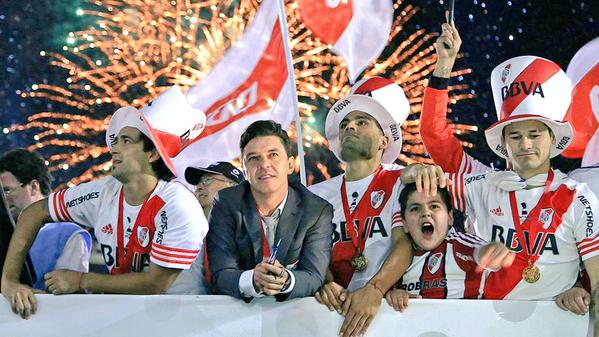
Just to emphasise River’s superiority over the past 12 months, influential Uruguayan newspaper, El País announced their South American footballer of the year and Los Millonarios dominated proceedings. Colombian striker, Teo Gutiérrez was honoured with the top prize after his crucial goals in all competitions but making up the podium were River’s midfield duo of Carlos Sanchez and Leonardo Pisculichi. 2015 brings the new challenge of Copa Libertadores football back to the Monumental and so there is no time to rest on their laurels.
As already alluded to, River were indeed pipped to the Torneo Transición title by another Argentine giant enjoying a remarkable renaissance. Racing Club have endured a difficult time over the past few years but after welcoming club legend Diego Milito back to El Cilindro, La Academia stormed to their first title since 2001. A near perfect second half to the season saw Racing reel in leaders River before crucially defeating Gallardo’s side in Avellaneda to leapfrog them with two matches remaining. Uncharacteristically Racing showed the necessary calm to complete the task and lift the Transición trophy.
Now while these events might have been the most significant on-field events of 2014, there was another seismic shift in Argentine football when long standing AFA President, Julio Grondona made good on his promise that he would only leave the Argentine Football Association in a coffin. The 82-year-old’s sudden death has left a power vacuum in the AFA and with his plan to increase the number of sides in the Primera to 30 already in motion, Grondona has managed to leave domestic football in a state of chaos.
The Transición was of course the pre-cursor to the new look Primera and with it there were no relegations but indeed 10 promotions giving some surprising clubs the opportunity to play in the top flight. Crucero del Norte and Temperley perhaps the major surprises were joined by the more familiar clubs of Huracán and Argentinos Juniors among six others. Argentinos were assisted by the surprise return of Juan Román Riquelme, who left Boca Juniors earlier in the year and opted to lend a sizeable hand to his boyhood club in their crucial promotion bid while Huracán also managed to lift the Copa Argentina after a deserved final victory over Rosario Central.

2014 also saw the retirements of two notable characters in Argentine football as first Gabriel Heinze said farewell to Newell’s Old Boys and then Juan Sebastián Verón called time on his outstanding career for the second time. This time it was for good but it did not take long for La Brujita to take up a new role with his beloved Estudiantes. In October, Verón won the club’s Presidential elections by a land slide margin and he is now tasked with bringing some of the honours that we won as a player back to the club.
 golazo argentino