
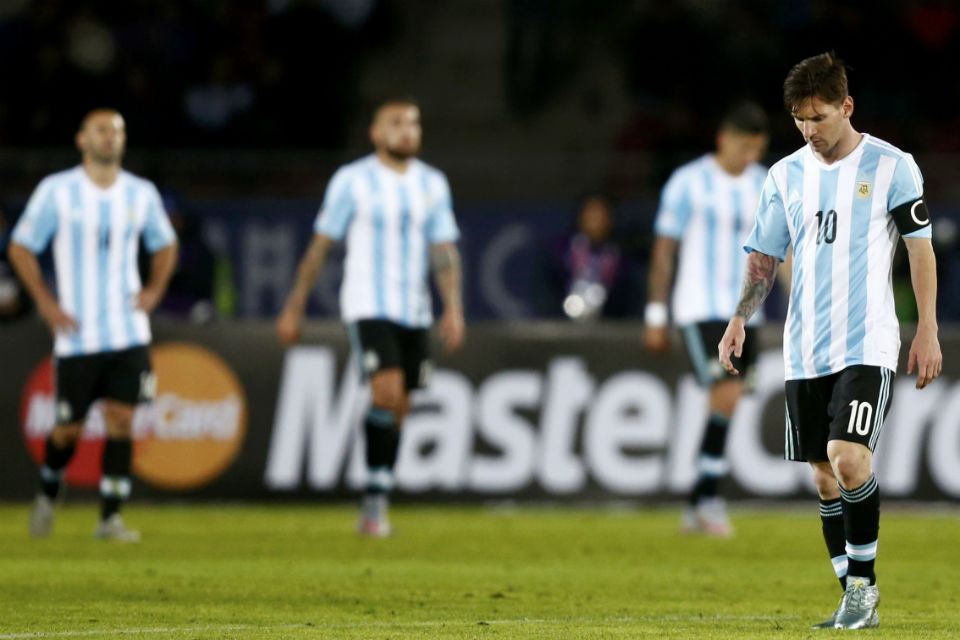
It is only the second match of the Copa América and already Argentina’s clash with Uruguay has the feel of a must-win about about it. Defeat for Gerardo Martino’s side would not mean they were out but after the disappointing draw with Paraguay would plunge them into crisis and so there is a real need to rectify the mistakes made on Saturday. The Clásico del Río de la Plata pits two of the continents oldest rivals against each other and the two most successful sides in Copa América history; it needs no further selling but after less than auspicious starts this one has perhaps taken on an added level of significance.
In Argentina’s opening match with Paraguay, La Albiceleste produced two almost polar-opposite performances: lauded in the first half for their attacking talent and castigated over their tactical naivety and sloppy defending in the second.
A point not lost on Argentina manager Gerardo Martino in the build-up to Tuesday’s crucial Group B match with Uruguay who obviously feels the level of criticism aimed at he and his players is a little unjustified: “We are being judged on our second half and not the first and that is our fault: in the first half we played probably the best football of the first round of the Copa América and in the second half we played the worst.”
Martino continued, “The first half was the best of my time in charge and that helps you to draw conclusions. We could have won 5-2 or 5-3.”
This much is perhaps true. Argentina’s first half performance was spectacular at times, certainly the best in the short amount of time that Martino has been in charge and had they been further in front it would have not been unjust. However, it does not excuse just how poor Argentina were in the second half of that match and does not explain why they were unable to protect what was such a clear advantage.
What is important is that there were some lessons learned from the second half performance and improvements made in terms of ball retention and tactical positioning. If Martino does not heed the warnings that Paraguay clearly provided, the 52-year-old coach could be in trouble.

Worringly, Martino’s statements in the build-up do not appear to focus on these obvious flaws. When asked whether he would make the same changes again, the former Barcelona manager answered: “Would I do the same thing again? It’s very difficult to give that answer now. You have a moment to decide. I have a clear idea of risks, when to take them, when it is convenient and when it is not, and I decided that the quality of Tevez and Higuaín could decide the game in our favour. The tendency will always be to take risks.”
Risks are all well and good but there are few who agree with Martino that the introduction of both Carlos Tevez and Gonzalo Higuaín against Paraguay when the game was so clearly slipping away from Argentina in midfield was a sensible move.
So, what changes will be made for Tuesday’s clash with Uruguay? Argentina are expected to line-up in a very similar formation but with two changes. Two changes that would have perhaps not had to be made in the first-place against Paraguay had it not been for injuries in the build-up preventing Pablo Zabaleta and Lucas Biglia from training all week.
Zabaleta is expected to replace Facundo Roncaglia at right-back after the Genoa defender experienced a testing second half and Biglia looks to regain his place alongside Javier Mascherano in the centre of midfield, at the expense of Éver Banega. The Mascherano/Biglia partnership was one that was forged in Brazil but is now the first-choice central midfield and while Biglia is not as destructive as Mascherano, he provides more grit and graft than Banega and should help shore up the midfield.
This then puts a degree of pressure on Javier Pastore after a somewhat mixed display against Paraguay. This is a real opportunity for the Paris St Germain playmaker in Argentine colours and with options on the bench, if he is not making much of an impact Pastore’s position will be one of those under most scrutiny.
So the starting eleven against Uruguay looks to be: Sergio Romero; Pablo Zabaleta, Ezequiel Garay, Nicolás Otamendi, Marcos Rojo; Lucas Biglia, Javier Mascherano, Javier Pastore; Lionel Messi (C), Sergio Agüero, Ángel Di María
Given that this is widely thought to be a first-choice eleven there will be no hiding places if there is not a positive performance and result from Argentina. Uruguay were less than impressive in their narrow victory over Jamaica and showed a similar defensive fragility but in youngster Diego Rolan, they will be hoping to take advantage of the lack of pace in Argentina’s defence.
Uruguay will certainly need to add a degree of creativity to their game after struggling against Jamaica but will perhaps be drawing confidence from the 2011 Copa América when they knocked out Argentina in Santa Fe en route to lifting the trophy. Fernando Muslera saved Carlos Tevez’s penalty in the shootout to give them the Quarter Final victory and they later defeated Paraguay to lift the Copa América for a record breaking fifteenth title, one more than Argentina.
This is a chance for revenge for La Albiceleste, not only to avenge the loss in 2011 but hopefully set Martino’s side on the road to levelling their rivals as the most decorated Copa América side. That is a long way off yet but a victory this evening is vital in obtaining top spot in Group B and a favourable draw for the knockout stages.
Statistics
-
In Copa América history Argentina and Uruguay have met each other 30 times and it couldn’t be more even with both sides winning on 13 occasions and with 4 draws.
-
Overall for the clásico, Argentina have the upper hand with 19 victories to 16 from 43 competitive meetings and 85 to 56 in the 183 matches including friendlies.
-
Argentina have enjoyed recent dominance winning 7 of the last 10 meetings but crucially Uruguay won on penalties in the Copa América 2011.
-
Argentina and Uruguay have played five matches in Chile. Three victories to Argentina, a draw and a victory for Uruguay.
-
The last victory for Argentina over Uruguay on Chilean soil was 6-1 in the Copa América 1955. The largest victory in the competition on neutral ground.
 golazo argentino