

“There’s nothing more painful in football than losing a final.”
Those were the words of Lionel Messi after Argentina had once again come up short and ensured that the national team’s barren stretch without a trophy goes on. The pain is still raw and the reactions extreme but after this must come a period of recovery and Argentina must look to the future. There is little time to dwell on defeat with World Cup qualification, another Copa América and the Olympics all just a year away but there must also be valuable lessons learned if the same mistakes are not to be repeated.
Such was the level of relief and joy at reaching the World Cup final in Brazil after a torrid run of failures stretching back to 1990 throughout which Argentina failed to progress beyond the quarter-finals there appeared to be little gained from defeat to Germany. The change in management overshadowed everything else but many of the same issues that ultimately led to Sabella’s shortcomings were repeated in Chile. A difficulty in breaking down well-organised, defensive sides, a disconnect between midfield and attack, opposition sides targeting the space in the channels behind the full-backs and Lionel Messi, for all his outrageous talents, having too much to do and not enough on-field chemistry with his teammates were all common themes.
Despite some of the vitriolic arguments from certain sections of the press there is no need for knee-jerk reactions. After all this is still a squad that has reached back-to-back finals, contains the best footballer in the world and is full of established world class stars. It isn’t a young squad at present, by any means, but it is also not past its sell-by-date with Martín Demechelis, who has since opted to retire, being the only player who would obviously not be available in three years time. For the majority of big-name stars, currently in their mid to late twenties, even Russia 2018 is a realistic goal. However, with a talented crop of youngsters pushing for places it is an important time to begin giving these players opportunities and time to settle into what has become quite a tight-knit squad.
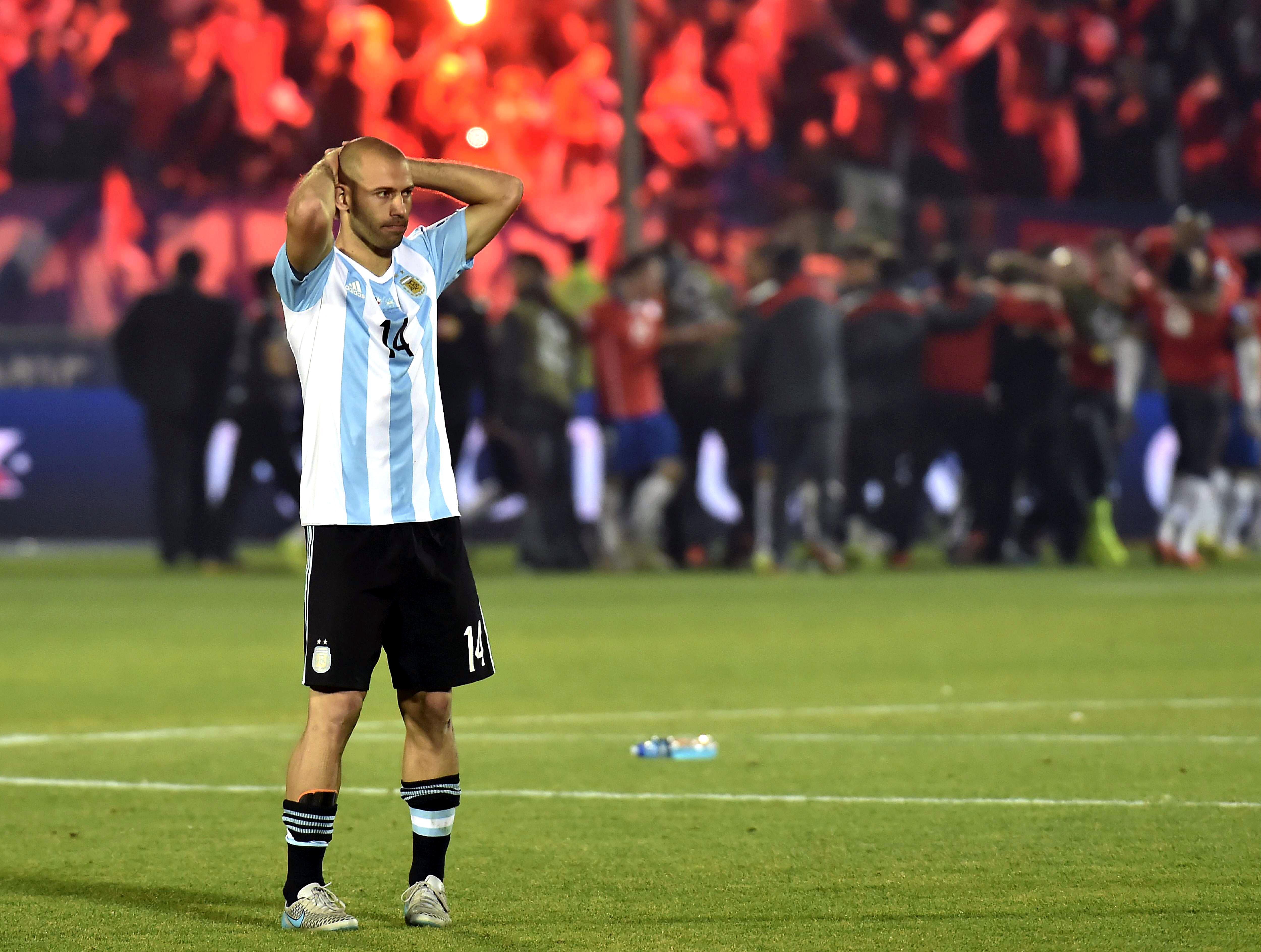
The weight of being the world’s best player leaves Lionel Messi open to most the criticism and in the aftermath of the Chile defeat there were some reports that the Barcelona talisman might decide to step away from international duty. Fed up of shouldering the burden and taking the abuse, reports ranged from a temporary break for the qualifiers up to a permanent withdrawl from La Albiceleste. There appears to have been no substance to any of these rumours and Messi has shown since the World Cup in Brazil that despite his quiet persona he is as desperate as anyone to bring success to Argentina. Vice-captain Javier Mascherano was also linked to retirement by his agent but moved swiftly to scotch the rumours leaving both presumably available for any upcoming fixtures.
Both will still be key to Argentina but finding the correct dynamic around them will be key. Messi can no longer be expected to play in the same role which is not getting the best from him and if Mascherano is to be Argentina’s number five then there must be a greater balance in the midfield and with the full-backs for when he drops back in between the centre-backs.
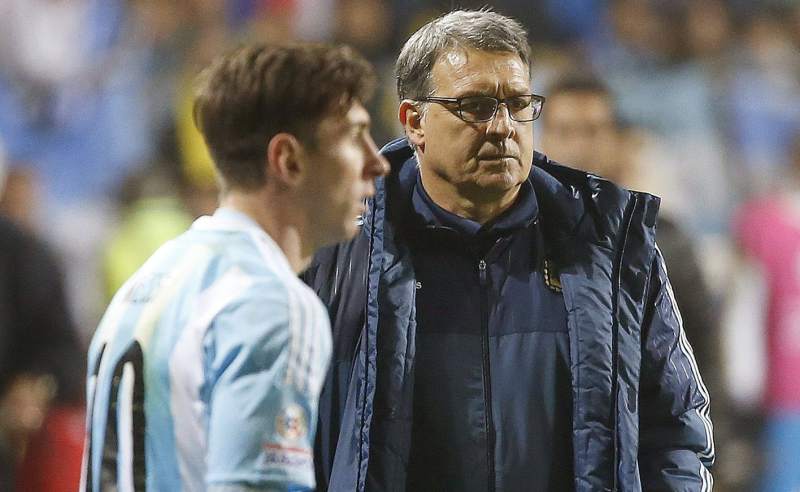
Where does the Copa América leave Gerardo Martino?
In most cases, reaching the final of an international competition only to lose on penalties would not see the manager come under any real pressure. Such was the case only a year ago in Brazil when the pessimism pre-tournament meant that Alejandro Sabella reaching the final was nothing other than a success.
Fast forward a year and with expectation now ramped up, Martino has not been awarded such luxuries. Amid the questioning of Messi and his teammates, the role of Gerardo Martino has already been questioned and many are unsure if he is the right man to guide Argentina forward into a World Cup challenge in Russia in 2018.
Firstly with more than a week since the defeat in Chile, Gerardo Martino is still the Argentina head coach and there have been absolutely no sounds to the contrary from any official or semi-official source so those holding out for that might want to resign themselves to a little while longer with Tata. In defence of Martino many of those most vehement critics were probably not hugely enamoured with his appointment in the first case; his trophy-less season with Barcelona brought with it a sense of negativity from which only a dazzling performance en route to lifting the trophy would have disspelled.
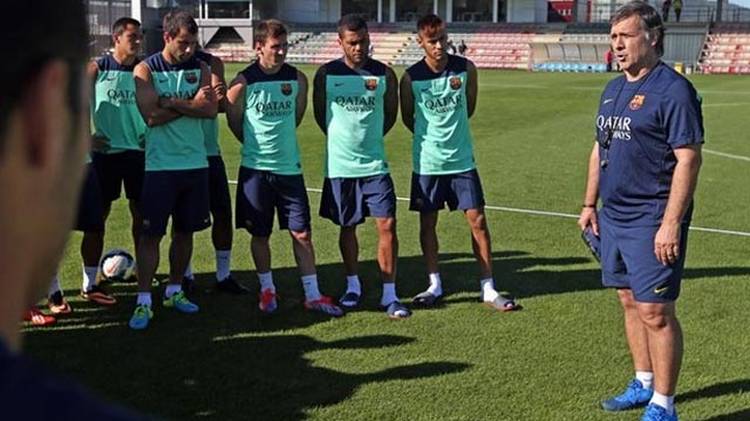
Without analysing Martino’s reign at Barcelona the 59-year-old coach did have some mitigating circumstances and perhaps never got off on the right foot with much of the Catalan and European press making it an uphill struggle. Even after guiding Barca to the best league start in the club’s history Martino’s side were still widely criticised and when things on the pitch went awry, it became obvious he would not last. This is far from a perfect analogy and it is certainly not an attempt to rid Martino of any responsibility but does highlight the difficulties of being a success in an atmosphere of expectant failure.
The fanatics aside though, there is justified concerns over Martino’s management looking at only his time in charge of the national team in isolation. The players made a point of saying that there was a different approach under Martino than there was under Alejandro Sabella, one which was more focused on possession and control. Control possession they did, prior to the final Argentina averaged above 70%, the highest in the tournament, but this did not translate to goals necessarily. Only in the semi-final against Paraguay, who foolishly allowed Messi time on the ball did Argentina look truly ruthless.
Don’t be mistaken when Argentina were good, which they were in spells during the Copa América, they looked wonderful. The passing was crisp, the interplay between Messi and Javier Pastore, someone who Martino brought in, was superb and they looked a side capable of posing a threat to any side. However, there appeared to be a lack of any alternative system and when Argentina were struggling to break down sides, Martino simply persisted in the apparent hope that a piece of individual magic would win the match.
Sadly this lack of invention cost Argentina in the final as Chilean manager Jorge Sampaoli successfully found a way to stifle and frustrate Messi and his cohorts. The Argentine manager said: “In Barcelona they all seek Messi and they always pass to him. For Argentina this is not the case and so it is easier to neutralize.”

Simply replicating Barcelona is impossible but there are obvious times when Messi has the ball and is desperately looking for a quick interchange of passes or the for the full-back to tear past him on the right to open space. Messi is still the key figure for his club side but he is not so easily marked out of matches.
Martino did not have a great deal of time to stamp himself on this squad. It was by and large still Sabella’s and with just a handful of friendlies before going straight into a major tournament perhaps it is too demanding that a new system is embedded into the players. What is important is that Chile provided a valuable learning experience – Martino must now assess who he can add to this group and what he can do differently to extract the very best from those players.
The future of coaching in the national team set-up
Even supposing that the Asociación del Fútbol Argentino (AFA) did agree that Gerardo Martino was not the correct man for the job, the organisation has proved time and time again that it’s collective judgement is impaired. After all, they hired Diego Maradona and have single-handedly compromised Argentina’s youth sides with a series of poor choices.
But entertain the idea that they were looking for successors to Martino for a moment – where would they turn? Firstly, any idea that AFA would turn to a foreign manager and pay the huge salary that would be required is a non-starter. Any far-fetched schemes of tempting Pep Guardiola to take over the role and reproduce his success with Messi from their Barcelona days are out of the question.
This leaves the group of qualified Argentine coaches to choose from and perhaps heading this list is Diego Simeone. The Atlético Madrid manager has transformed Los Colchoneros into La Liga and Champions League title contenders and is understandably, given his status as a player for La Albiceleste, constantly linked to the top job in Argentina. However, when quizzed on whether he was approached when the AFA were looking for Alejandro Sabella’s replacement, Simeone said: “No, but I know it’ll happen one day.”

Simeone further explained why at the moment the Argentina job is not for him, “I’ve always said in the national team you have room for what I call the son, father and grandfather types. In coaching terms, I think it’s a place for a grandfather — someone more serene and composed who can see things in a different way. I still feel I need to be on the pitch, doing training and being with players day-in, day-out. The national team cannot give you that.”
Simeone is certainly one for the future but does not appear in the running. Even if he were, there are some corners who would describe Cholo as a rather defensive coach. His strong work ethic produces a side who will cover every blade of grass with a win at all costs mentality (sometimes if it requires getting a little ugly) which is perfect when coaching an underdog side like Atleti but would perhaps need a different approach when in charge of Argentina, where the old phrase ‘Ganar, Golear, Gustar’ would be more applicable.
Other than this there could be arguments made to bring José Pékerman back if he was willing to walk out on Colombia or even Marcelo Bielsa but neither man were actually able to lift a significant trophy in their spells as Argentina manager. Perhaps the man who outsmarted Martino in the Copa América, Jorge Sampaoli would be a candidate but there is no indication that this is the case.
The mention of José Pékerman though does introduce the wider footballing landscape and some of the deeper problems that have plagued Argentina in recent years. Pékerman understood the value of youth football and the importance of molding the players during these crucial periods of development so that they can contribute to the senior side. Under his stewardship in the late 1990s and early part of the 2000s Argentina ruled the roost at under-20 level winning three world cups but continuing to enjoy success after he had moved up to the senior side, adding two further titles in 2005 and 2007.
This blueprint for development saw most of the current Argentina side pass through his sides and created what many have deemed as a golden generation. However, the AFA have gradually seen this level of Argentine football fall into decline and since their last World Cup triumph the under-20s have failed to qualify for two of the four tournaments since.
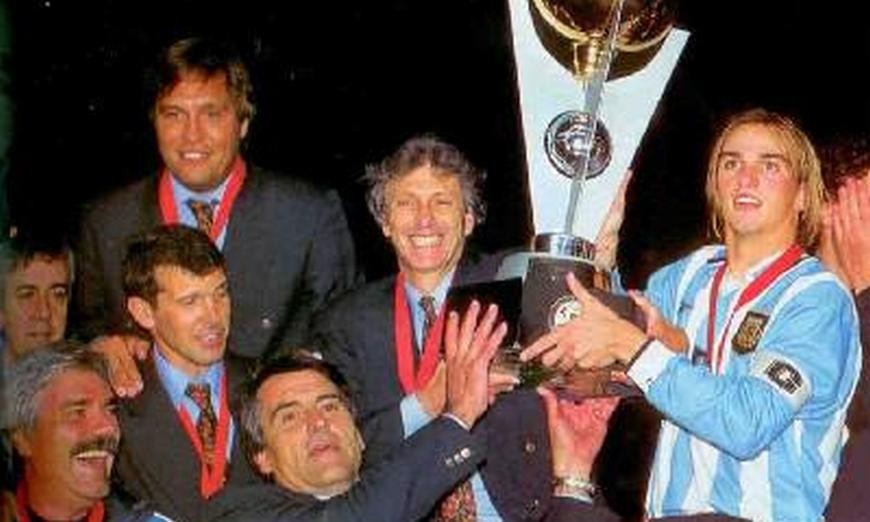
It would be easy to suggest that the players are just not as good but when you look at the squad for example that failed to reach the 2013 World Cup it contained Luciano Vietto, Matías Kranevitter, Juan Manuel Iturbe and Manuel Lanzini among others. The issue was the succession of ill-appointed coaches or AFA ‘yes men’ culminating in the act of nepotism that saw AFA president Julio Grondona’s son, Humberto Grondona take charge most recently.
Even the success of Grondona, winning the Copa Sudamericano in January seemed to owe far more to the individual talent of Ángel Correa and less to Humbertito’s tactical acumen. The side travelled to New Zealand recently as South American championships and were on the first flight home after crashing out of the group stages.
The importance of this stage and its role in the senior side cannot be understated and when someone like Grondona is at the helm playing prodominently a 3-4-3 system that none of the players will be familiar with at club level and will never likely play when graduating to the senior side is ludicrous. Continuity and good coaching is needed so that the transition is a seemless one.
Gerardo Martino knows this and should be given credit for demanding far greater input into these levels of Argentine football when negotiating his deal as head coach with the AFA. Humberto Grondona’s cycle in charge of the under-20s should have come to an end after the debacle in New Zealand and with Martino adamant that he will take charge of the Olympic side and overhaul coaching of the youth divisions perhaps Argentina can begin working towards the future again.

So which players could be pushing their way into the squad soon?
One of the pre-Copa América criticisms of Gerardo Martino was his reluctance to call upon any of Argentina’s newer generation. After some dazzling displays at club level during the 2014/15 season there were some obvious candidates but Martino opted to stay more or less faithful to the core of players that had taken La Albiceleste to the World Cup final twelve months earlier under Alejandro Sabella.
Now given that it was only a year prior that Argentina had reached a World Cup final and the changes to the squad that Martino did make strengthened the squad, Argentina certainly had a group more than capable of lifting the Copa América. With 2016 providing not only a centenary edition of the Copa as well as an Olympic games, Martino would have plenty of opportunities to take a closer look at some of these new players and this would still give two years before the World Cup in Russia. After the disappointment of defeat now would be an ideal time to begin to introduce some new, younger players in place of a few of the older players who failed to impress in Chile.
Just as it is with the current crop, the options coming through are weighted towards attack and if the indications are anything to go by Argentina’s reputation for having a wealth of resources available up front whilst being a little light at the back is not going anywhere.
The three names that were strongly linked with this Copa América squad but who missed out were Mauro Icardi, Luciano Vietto and Paulo Dybala and all three will now be pushing even harder to make the squad. Icardi would certainly fit the criteria of the ‘number nine’ that Martino discussed before his squad announcement for Chile and with the 22-year-old striker finishing as Serie A leading scorer in what was a poor Inter Milan side, the time for the Rosario-born centre-forward is maybe now. Few can doubt Icardi’s finishing ability but Martino has publically questioned his profile and it remains to be seen if this will be forgotten when the next squad is announced. Javier Mascherano was a teammate at River Plate of Maxi López the former husband of Icardi’s current wife, Wanda and there have been suggestions previously that the senior members of the squad would not be keen on Icardi’s inclusion.

Luciano Vietto and Paulo Dybala appear to carry no such baggage but enjoyed equally fruitful breakthrough seasons in Europe and have earned themselves big money moves in this transfer window. 21-year-old Vietto impressed with Villarreal and after being probably the best young player in La Liga, Diego Simeone decided to reunite with his former Racing prótegé at Atlético Madrid for a reported £15 million. Dybala also announced himself on the European scene with 13 goals and 10 assists in Serie A for Palermo, leading to champions Juventus paying a massive €32 million (plus €8 million in add-ons) for the tricky striker.
Interestingly Dybala replaced Carlos Tévez at the Bianconeri after the ‘Jugador del pueblo’ decided to return home to Boca Juniors. With Tevez now 31 and playing in the Argentine Primera this changing of the guard could well be at international level also and all three of those already mentioning will be eyeing these spots in the Argentina squad. Gonzalo Higuaín has fallen out of favour after his miss against Germany in the World Cup final coupled with his display in Chile and Ezequiel Lavezzi has become more and more of a fringe player. These three changes are very possible and would immediately bring a renewed vigour to the Argentina front-line.
However they are not the only forwards on the radar of Martino and his coaching staff. Ángel Correa has already led the under-20s to Copa Sudamericano glory and following his heart surgery he is ready to test himself with Atlético Madrid. The tricky second-striker could take some of the creative strain off Lionel Messi if he progresses in the way many who have watched him since his San Lorenzo days think he could.
Any other forwards currently plying their trade in Europe may eventually challenge but the likes of pacy Juan Manuel Iturbe, tricky Lucas Ocampos or centre-forward Guido Carrillo must prove themselves on a consistent basis before even thinking about the national side.

Argentina are well-stocked in attack but they are also in good hands (excuse the pun) in the position of goalkeeper. Sergio Romero has never let down the national team but continues to struggle to get regular playing time at club level and the longer that this situation goes on, the more his status as number one comes under threat.
At 28, Romero can and most likely will remain in or around the Argentina team for the next few years but he can expect serious competition from Real Sociedad’s Gerónimo Rulli. The 23-year-old was very unfortunate not to be taken to Chile and would have benefitted from the experience given that he has all the crendentials of a future Albiceleste keeper. The youngster immediately impressed with Estudiantes and has never looked out of depth since moving to Spain. Coming behind Rulli in the next wave would be current under-20 keeper Augusto Batalla but at 19 and yet to play for River Plate’s first team there is plenty of time for him.
The midfield in Chile had an almost identical feel to it from the World Cup other than the inclusion of Javier Pastore. Martino has certainly not found the balance with his preferred midfield three between providing cover for the defence but also getting forward and linking the attack. Javier Mascherano and Lucas Biglia look set to be around for a little longer yet and perhaps Valencia’s Enzo Pérez would have remained in the plans had injured not interrupted his season in Spain. Certainly Pérez provides a little more box-to-box action which the midfield at times lacks and although his international career is not over, the 29-year-old is not one for the future.

The obvious candidate from the younger generation to be incorporated in the central midfield is River Plate’s current number five, Matías Kranevitter. If newspaper reports are to be believed, the 22-year-old will be an Atlético Madrid player at the end of year but he has already displayed enough of the characteristics for River both in the Primera and the Copa Libertadores to suggest he is an heir to the throne of Mascherano. Quick and clean to the tackle but efficient in possession Kravevitter is a classic Argentine defensive midfielder and it will come as no surprise to those who have watched him for River if he goes on to prove himself in Europe.
The ‘number five’ role is one that Argentina appear to creating an adundance of at the moment and others like Adrián Cubas or Lucas Romero are still in the scope of the youth coaches. However, they are some steps behind Kranevitter in their development and are not ready for the enormous step-up at present.
Those midfielders who play further forward and link play are a little harder to find but perhaps Érik Lamela will have a second wind after seeing his progress stunt at Tottenham or maybe Nicolás Gaitán will get another opportunity having missed out on a place in Chile. There is a chance for Rodrigo De Paul or Bruno Zuculini to push on too but they remain on the periphery until they claim regular starting roles.
The much maligned Argentine defence has in fact performed admirably over the last two major tournaments and although in Ezequiel Garay and Nicolás Otamendi, Martino appears to have found a solid central defensive pairing with a good few years ahead of them, the need for reinforcements and competition at full-back is needed. Pablo Zabaleta, remains reliable but is nearing the end of his career, while question marks continue to linger over Marcos Rojo at left-back.
Lucas Orbán, despite being a year older than Rojo, could be one option on the left having played predominantly in this position throughout his career but like the Manchester United player is capable of playing centrally. Orbán will need continued playing time at Valencia to really push Rojo but perhaps Sporting Lisbon youngster Jonathan Silva will provide a longer term solution. The 21-year-old has already been capped and having made the switch to Europe is ideally placed to push for a spot.
The right side is a little more complicated with Martino looking at Facundo Roncaglia prior to the Copa América but obviously not being convinced by the Marseille full-back. 23-year-old Gino Peruzzi is attempting to rebuild his career with Boca Juniors after a failed move to Catania and there is no reason why the natural wing-back cannot regain a position in the Argentina squad but he is not at that level just yet.

 golazo argentino
Yes all the Young stars are so talented & will lift the Title in near Future.just needed a Very Good Coach lIke Diego Simeone or George sampaoli type on a long term basis.