
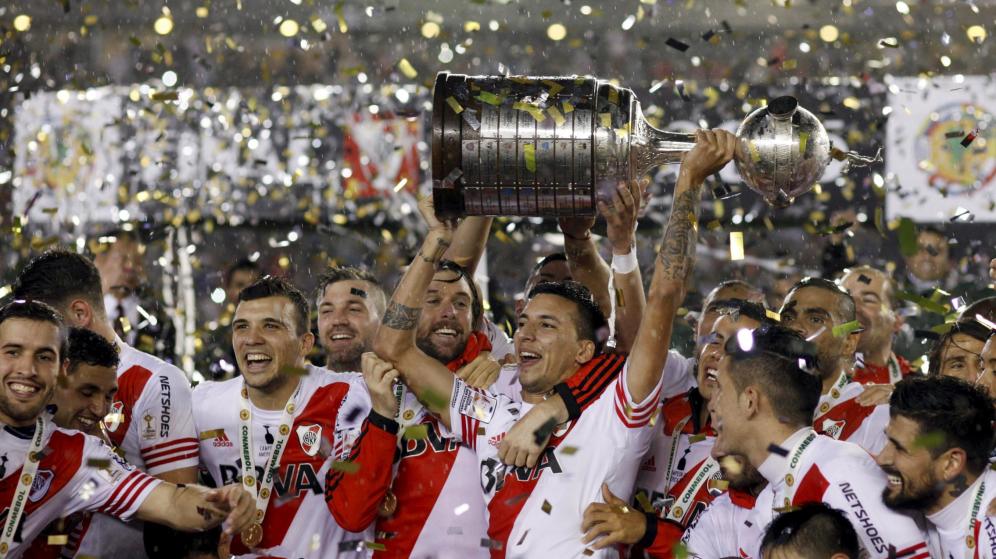
Amid the cacophony of noise inside the famous Estadio Antonio Vespucio Liberti, River supporters are in floods of tears. However, the scene could not be more different to four years prior when River Plate and its nationwide legion of supporters were left broken after suffering the ignominy of the first relegation in the proud history of the club. The pain in the stands inevitably led to anger and riot police fought back the crowds with water cannons. Four years on and the supporters are once again sobbing uncontrollably and soaked to the bone, the driving August rain now the cause, but River Plate are champions of South America for the third time. A remarkable rise from despair to joy in a fraction over four years has put River firmly back at the top of the continent’s football.
With the eye-catching red sash across the chest, River is perhaps the most recognisable club in South America but beyond their aesthetically pleasing kit, Los Millonarios represent the strength and success of Argentine football. Even those with little or no interest in South American football recognise River and there are some pretty strong footballing reasons for this too. A glittering history littered with 36 league titles and displaying some of the best players that the country has produced means there have been very few bad times.
The legendary ‘Máquina’ side of the 1940s spearheaded by Ángel Labruna, the great Alfredo Di Stéfano just after, and later, the likes of Daniel Passarella, Enzo Francescoli and Hernán Crespo had left the supporters somewhat spoiled. Only a seventeen-year spell between 1957 and 1975, when River did not lift a league title, could be anywhere near described as a ‘bad time’.
However, even throughout this barren spell, River were still nearly always challenging and finished runners-up on several occasions. The trophy-famished supporters of this era were craving success but nothing could prepare them for the shame of June 27th 2011.

The relegation play-off defeat to Belgrano on that day was the culmination of years of mismanagement from the boardroom level down to the pitch. On-going power struggles with the barra bravas – Argentina’s organised hooligan groups – and a debt to the tune of around $75 million when José Maria Aguilar departed as club president had left the club in a precarious position. Matters on the playing field had not been much better. The embarrassment of a Copa Libertadores first round exit in 2007 thanks, in part, to defeat in the Monumental to Caracas FC – the first time a Venezuelan side had won in Argentina, finishing bottom of the 2008 Apertura table all contributed to a growing dark cloud over the club.
The fact that relegation took at least three years of decline to become a reality is proof enough of just how far River had fallen. The average points system worked out over three seasons to determine which sides would descend to the Nacional B, was introduced to protect the big clubs like River, so one ‘blip’ could be erased and their Primera status could be maintained. By the time the 2011 Clausura came round, River were in the thick of a relegation battle and despite battling until the end, the 1-1 draw in the Monumental against Belgrano in the second leg of their playoff sealed their fate.
The great River Plate were outside the top flight for the first time in their 110-year history and the anguish of the supporters was only rivalled by the glee felt by their adversaries at Boca Juniors or the other big Buenos Aires clubs. ‘RiBer!’ graffiti and posters quickly daubed walls around the city, mocking their status in the second division and a group of Boca supporters defaced the club logo at the Monumental so that the CARP (Club Atletico River Plate) now read CAPB or more damningly ‘Club Atletico Primera B.’ Boca reveled in their status as one of only two (at the time – as Independiente have since followed River’s decline) sides that had never been relegated and ensured that their enemies would never forget the shame that 2011 brought.
Manager, Juan José López departed in the aftermath and the newly retired Matías Almeyda was tasked with the potentially hazardous job of gaining immediate promotion back to the Primera. Former fan favourites, Fernando Cavenaghi and Alejandro Domínguez returned to strengthen the squad and were supplemented by David Trezeguet and Leonardo Ponzio midway through the season. Despite not running away with the title, River remained in the promotion places all year and sealed the championship on the final day with a 2-0 victory over Almirante Brown.

River had plunged to almost unimaginable depths but the club had galvanized and reaching the top flight at the first attempt was not only necessary but showed that the gears of the machine were beginning to turn once more.
A first season back saw River finish a respectable eighth but after disagreements with president Daniel Passarella, Matías Almeyda was fired with two matches remaining of the Torneo Inicial, paving the way for another familiar face from River’s past. Ramón Díaz swaggered back into the Monumental, in a managerial move which is all too familiar to Argentine football. When times are tough, look to the past and bring back a successful old head. Restless supporters can’t possibly have any grievance with a man who won five league titles as a player and a further five plus a Copa Libertadores as manager between 1995 and 2002.
Díaz certainly gave no reason to grumble as River’s momentum showed no signs of waning and in his first full season back in charge, the 2013 Torneo Final, Los Millonarios were only surpassed by Gerardo Martino’s talented Newell’s Old Boys side. It was also during this season that some of River’s talented youngsters began to break through. The likes of Matías Kranevitter and Éder Álvarez Balanta were gaining valuable minutes and the bones of the team were beginning to form.
The lofty runners-up spot saw River back in continental competition and although the Copa Sudamericana run ended at the quarter-final against eventual winners, Lanús, affecting their league form detrimentally, it proved to be a valuable experience for the squad, as they learned to deal with the strain of midweek fixtures. At this point it was not obvious, but the ordeal of relegation and this process of rebuilding had well and truly awoken River from their slumber and 2014 was to be the beginning of a glorious new chapter in their illustrious history.
Díaz had now had time to mould his side and without the distractions of other competitions, River were expected to attack the 2014 Torneo Final. They did just that. The experienced and talented attack of Fernando Cavenaghi and Teo Gutiérrez, ably backed by Manuel Lanzini and Carlos Carbonero and built upon a miserly defence proved to be too strong for the rest of the competition. A first victory in La Bombonera for more than ten years provided a perfect riposte to their rivals relentless barbs over relegation and a thumping 5-0 victory over Quilmes on the final day ensured River were lifting the trophy in style.

Buenos Aires erupted into a sea of red and white as the supporters savoured every second of an even more significant 35th league title. A week later, Los Millo added the Superfinal title with victory over Torneo Inicial champions and current Copa Libertadores champions, San Lorenzo. Celebrations were still in full-swing when Díaz decided he had done his part and resigned. The 55-year-old walked away with his iconic status only enhanced at the Monumental saying: “My objective was to take River to the top and I believe we have achieved that. When I arrived at this club only relegation was spoken about and now it makes me very happy that River are leading at the highest level.”
This sentiment was echoed by new president, Rodolfo D’onofrio, who told supporters upon his election that the club must seek to add fresh triumphs and not focus on the stain of relegation. This he said was ‘indelible’ but success would render it meaningless. The Torneo Final 2014 was part of that but when Díaz spoke about reaching the top he was not to know that in fact, he had merely guided River to the camp prior to the push to the summit.
Just as the club had done when they appointed Diaz, D’onofrio opted for a familiar face. Marcelo Gallardo was among the substitutes, used by Ramón Díaz, the last time that River lifted the Libertadores in 1996 and had only retired three years prior but had begun a promising managerial career in Uruguay with Nacional. Díaz had brought experience but the hope was that a young, up and coming coach like Gallardo would bring River into the modern game.
River were not disappointed. Off the pitch, Gallardo took a more scientific approach that was common in Europe but less so in South America, employing sports psychologists to work with the players, whilst, on the pitch, El Muñeco took the champions and improved them. Their high-tempo pressing and ability to adapt to playing possession football or breaking at speed drew praise and saw River embark on a club record unbeaten run that stretched over thirty matches and began comparisons with some of the great teams of yesteryear.
Gallardo’s River were the team to beat during the 2014 Torneo Transición and young Matías Kranevitter had truly emerged as the natural heir to the long list of outstanding Argentine number fives. His metatarsal injury just weeks into the season coupled with the difficulty of balancing the demands of the Copa Sudamerica meant River came up just short in capturing back-to-back titles. Racing Club lifting the Transición might have been cause for disappointment but in the meantime River were on the verge of capturing a first international trophy in seventeen years. La Academia were ending a trophy drought of their own but they were undoubtedly aided by River having the preoccupation of a superclásico Sudamericana semi-final. River’s defeat to Racing during the title run-in essentially handed them the trophy but was forgotten when Leonardo Pisculichi scored the only goal over two hard-fought, physical legs to dump Boca out of the tournament and put River into the Copa Sudamericana final.
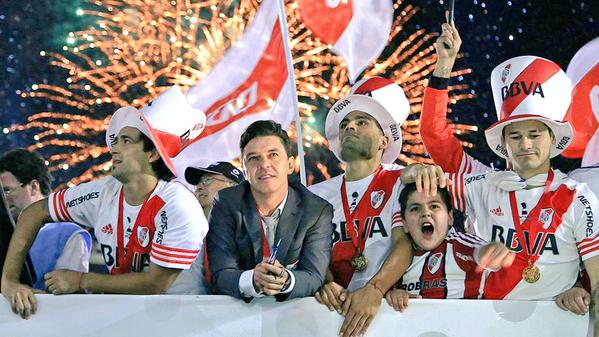
It had been eleven years since River’s last international final and on that occasion Marcelo Gallardo was one of the players who tasted defeat and saw Peruvian side Cienciano walk away as Sudamericana champions. In 2014, as manager, a 2-0 victory over Atlético Nacional in the second leg of the final on December 10th ended the wait for international success and provided Gallardo with a second major trophy (the first being a league title in Uruguay) in just two years of management.
The Copa Sudamericana is now a far more competitive tournament and lifting it is a feat in its own right; River were now considered one of the continents top sides but the Copa Libertadores is still the true indicator of this.
River began 2015 by further enhancing their credentials with victory against Libertadores champions, San Lorenzo for the Recopa Sudamericana and were installed as one of the pre-tournament favourites to succeed El Ciclón as holders of the biggest prize in South American football. However, qualification was not as straight-forward as expected.
Opening day defeat in Bolivia to San Jose was followed by four consecutive draws meaning River went into the final group game requiring a favourable result between group winners Tigres and Juan Aurich and victory against San José. Luck shone on Gallardo and while his side did what was needed in the Monumental, Tigres chalked up a remarkable 5-4 victory in Peru ensuring passage into the knockout stages as the lowest ranked side.
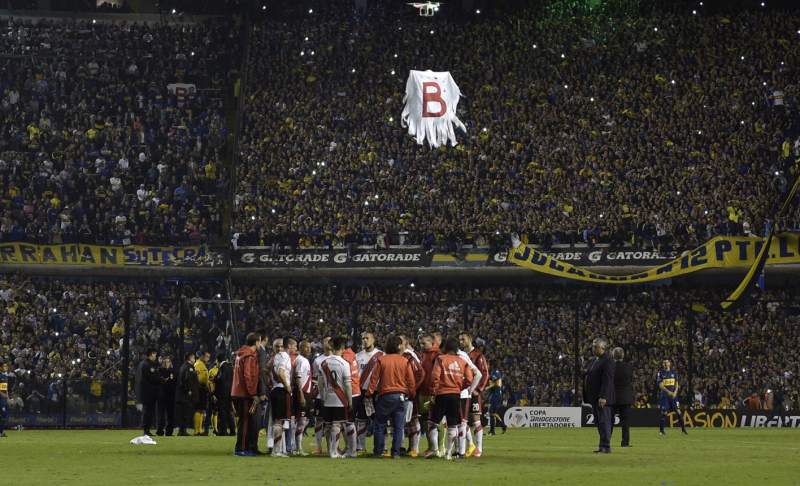
Twelve months earlier, San Lorenzo had benefitted from similarly remarkable circumstances and emerged as champions and in 2015 River were hoping for the same. Fate would see River pitted against Boca Juniors, who had cruised into the last 16 with a 100% record, and witnessed Gallardo slightly tweak his side to play with the ‘double five’ of Kranevitter and Leonardo Ponzio. This provided River with a far more solid structure and after a narrow 1-0 win in the Monumental, the two sides met again in the Bombonera with everything at stake. Still goalless at half-time, the now infamous ‘pepper-spray’ attack on the River team had the match abandoned and Boca were expelled from the tournament.
 golazo argentino