

“I am the only one responsible for this elimination, the players gave everything and it should not be held against them.”
Argentina under-17 coach, Miguel Ángel Lemme uttered these words this past weekend after overseeing the latest failure in La Albiceleste’s remarkable fall from grace in world youth football. What was once the envy of footballing nations across the globe, the breeding ground for so many of the great Argentine icons over the past fifteen years and a system which yielded ten titles in twelve years has been reduced to merely a high-profile scalp for the smaller federations and which, this year, suffered the ignominy of first-round elimination at both the under-17 and under-20 World Cups.
Three defeats from three matches, including against Australia in the decisive final group game, eight goals conceded and no goals scored from open play sums up Argentina under-17s limp World Cup campaign in numbers. Lemme’s attempts to deflect criticism from his young squad graciously laid the blame at his own door but since 2007 this has become an alarming pattern and one which would be optimistic in the extreme to suggest that simply replacing the 62-year-old would fix the system.
This is not an excuse of Lemme, far from it, but his apparent lack of coaching or tactical acumen is indicative of the era post-Hugo Tocalli. Argentina has always, and will hopefully continue, to produce incredible individual talents and what the AFA and their coaching staff must do is to mould this into a collective, cohesive unit. Nurturing and developing these talents but at the same time drilling into them a team ethic and a system which will hopefully be consistent as they graduate through the layers of youth football into becoming full internationals.
One man who understood this model and valued its importance was the now Colombia coach, José Pékerman, who took over as under-17 and under-20 boss in 1994 and sparked an era of Argentine domination. His appointment prompted some raised eyebrows at the time given his experience solely with the youth sides of Chacarita Juniors, Argentinos Juniors and Colo Colo in Chile but Pékerman grasped the concept of the project and along with Hugo Tocalli implementated a structure that the Argentina senior side is still benefiting from today.
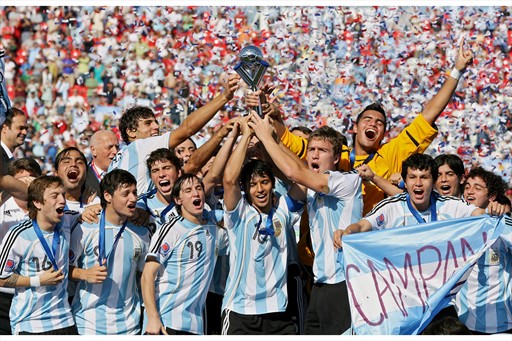
Over the next twelve years the duo masterminded several major tournament victories beginning with the 1995 under-20 World Championship and ending, under just Tocalli, with a fifth world title from seven tournaments in 2007. The list of players that came through these sides is equally astounding; Juan Pablo Sorín, Esteban Cambiasso, Juan Román Riquelme, Pablo Aimar, Javier Saviola, Javier Mascherano, Lionel Messi and Sergio Agüero to name a few that went on to achieve great things at senior level. One might argue that Pékerman was simply fortunate to inherit an era so rich in talent but the youth sides that spanned the twelve year period were replaced on an almost yearly basis and yet Argentina continued to churn out great teams and sides which harnessed these individual talents rather than relied on them.
The under-20s lifted five World Cups and three South American championships and while the under-17s were not as successful, only claiming a couple of continental titles, they were regulars at the latter stages of the World Cup. This in itself, raises a salient point; the development of these players at major tournaments is more important than the titles themselves. At under-17 level, Argentina were not as successful but at an age where players are not physically mature yet, there are mitigating factors and the enormous success of a nation like Nigeria, that has won a record four World titles but failed to translate this into senior honours, illustrates this. What is important is the team learn a system, positional sense and responsibility and grow as a unit into the under-20s and beyond.
The contrast in Argentina’s fortunes since this period is startling with the under-17s only making it past the World Cup quarter-finals once and the once formidable under-20s not even qualifying on two occasions and otherwise having a best finish in 2011 when they reached the quarters. The effect this appears to have had is a decrease in the rate of graduates from under-20 level into the senior squad and at the 2014 World Cup, Argentina travelled to Brazil with the oldest average age of any squad in the tournament.
The start of this decline can be traced back to Tocalli’s resignation in 2007 after AFA president Julio Grondona all but fired under-17 coach, Miguel Ángel Tojo. Alfio Basile had replaced Pékerman in the top job and Grondona now appointed Sergio Batista to take charge of the under-20s. Aside winning gold at the 2008 Olympics, Batista’s reign was a disaster and just two years after lifting the World Cup in Canada, Argentina failed to qualify for the tournament in Egypt in 2009.
 golazo argentino