
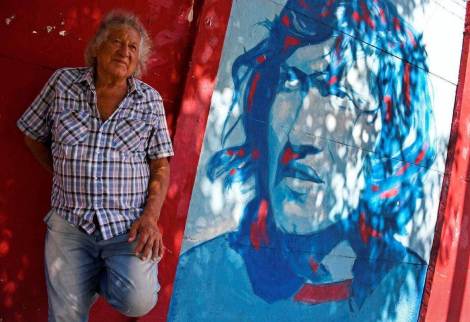
Argentina mourns on Friday morning the tragic passing of one of its greatest ever players. Though the wider world might not be aware of Tomás ‘El Trinche’ Carlovich, for those that witnessed his talents there were few better to grace the pitch. And so it is with shock and great sadness that football supporters from across the country react to the news that the 74-year-old died from head injuries suffered in a robbery.
Carlovich had been in intensive care since Wednesday after the icon had been attacked in the street for his bicycle in his home city of Rosario. The injuries caused a stroke and Trinche slipped into a coma before requiring emergency surgery on Friday. An operation which would ultimately prove too much.
A heartbreakingly tragic end for one of Argentinian football’s cult heroes. The grief is still raw and the injustice of such a senseless death will never be forgotten yet nothing can overshadow the legend of El Trinche that already exists.
Upon arriving in Argentina, my now brother-in-law told me about this remarkable player who people claim was the greatest ever despite never playing for the national team and spending his career in the lower leagues. As an obsessive football fan, I was already hooked and so with little more information than the name ‘Trinche’ I began trying to find articles and stories to learn more of this mythical player.
Stumbling across Michael Robinson’s 2011 documentary for Canal+ only fuelled my intrigue and prompted me to write my first ever article which ended up published by In Bed With Maradona.
How could you not be captured by such a story? The adoration from the people of Rosario, the testament of the likes of former Argentina managers César Luis Menotti and José Pékerman, rumours of being paid bonuses for the number of nutmegs performed and the tales of this lower league magician tormenting the national team.
It was April 1974 with Argentina preparing for the World Cup that a friendly against a regional XI in Rosario was organised. The local giants of Newell’s Old Boys and Rosario Central understandably dominated with the talents of Mario Zanabria from the black and red half and a young Mario Kempes representing the yellow and blue among a decent regional side. But one surely not strong enough for the might of the Albiceleste.
Selecting five players from each Rosario side left one space and coaches Juan Carlos Montes and Carlos Griguol opted for Tomás Carlovich. The 27-year-old midfielder plying his trade for relative city minnows Central Córdoba had come through at Central but opted for the quieter life of lower league football.
Unwilling to allow that to hold him back Trinche took full advantage of his moment on stage and in the glare of the spotlight outshone all those supposed to star in West Germany in a couple of months. Leading 2-0 at half time with Carlovich at his mischievous best, the midfielder’s non-appearance after the break sparked rumours that Argentina had requested his withdrawal. Rosario would end up 3-1 winners regardless but the day belonged to El Trinche.
By his own admission, this son of a Yugoslavian immigrant deeply attached to his familial ties in Rosario, never aspired to be a professional footballer and while Rosario Central first offered an opportunity to fulfil the dream of most (or the non-black and red half anyway) growing up in the port city, Trinche was different.
A brief spell at Flandria upon his release from Central followed before a return home with Central Córdoba, the first of three spells at the club that Trinche would later describe as one of the loves of his life.

 golazo argentino