

By Eduardo Razo
When a club in Latin America decides to pay a $15 million transfer fee, they’re expecting a difference-maker. It should be a player that will become a critical factor in their starting eleven for several seasons. Nonetheless, CF Monterrey is waiting for Maxi Meza to be that player that helped Club Atlético Independiente win the Copa Sudamericana in 2017.
Having arrived during the winter transfer window for the 2019 Apertura season, Meza is still trying to live up to the transfer price Rayados paid. There’s no question when a player moves to a new country and league; there’s an adjustment period. However, supporters don’t have that type of patience, especially for that transfer fee.
Since arriving in Monterrey, the 27-year-old has played all over the pitch for the Mexican club. It displays the versatility that Meza possesses as he plays on both the left and right sides of the midfield. He’s also seen time as an attacking midfielder and on the wing positions.
With the ability to play all over the pitch, one would think that Meza is regularly in the starting eleven. That’s not the case, however.
Using the data provided by Wyscout shows where Meza has regressed, stayed the norm, or improved while in Mexico – considering that the numbers would lead someone to believe that the Argentina international is a regular starter rather than an expensive bench player.
All this data analysis will include league, domestic cup, and international competition. Let’s begin with Meza’s overall time in Superliga Argentina and Liga MX on the attack. There are a couple of notable statistical differences when dissecting his numbers; most notably, his dribbles and offensive duels won per 90.
While at Independiente, Meza averaged 8.4 successful dribbles per 90, with a 52.8-percent success rate. When transitioning over to Monterrey, the 27-year-old has seen that decrease. Meza’s successful dribbles are down to 6.5 per 90. Seeing the decline in winning his dribbles, it’s affecting the number of offensive duels he wins. Below is a chart from his dribbles from the past calendar year.
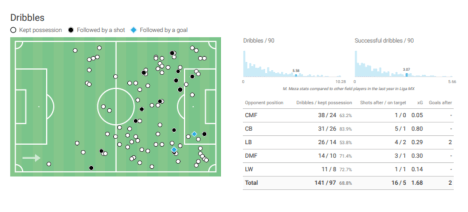
During his time with El Rojo, Meza was winning 16.1 offensive duels per 90. However, like his dribbles, those numbers took a dip when he moved to Liga MX. With Monterrey, his offensive duels per 90 fell to 14.9. Despite the drop in some attacking statistics, Meza’s performance remains the same when analyzing the data.
Meza averages roughly the same number of shots on target, passes, and total successful actions in Mexico as he did in Argentina. With the numbers being approximately the same, it begs the question, why the struggle?
Taking a look at his ball progression, a significant amount of Meza’s progressive passes and runs. These are more effective when he’s heading into the final third rather than creating chances near the penalty box. When it comes to his progressive passes, Meza is averaging 6.4 per 90, with an 83.8% success rate. Also, he’s smart with his passes as he’s averaging 1.4 smart passes per 90, and that puts him in Liga MX’s top 20 for that category.
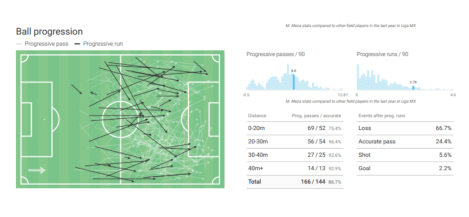
Meanwhile, Meza’s progressive runs occur since he’s averaging 3.1 per 90. His progression of a play favors the pass rather than a with the ball at his feet dribbling. Furthermore, the event following a progressive run, 66.7% of his runs results in a loss of possession. Only 24.4% of the runs that Meza does lead to an accurate pass. By looking at the chart and numbers, the Argentina international is more comfortable helping guide the attack rather than creating.
Other charts show why Meza is better off as some to help push the attack rather than create. One of them is his passes in the penalty area. In the final third and around the penalty box, the 27-year-old is middle of the pack with his passes. Meza is averaging 3.3 passes per 90 into the penalty area with a 47.1% accuracy rate.

However, Meza isn’t exactly someone that will provide the key pass with only six total in the penalty area. Nonetheless, he does make effective passes in areas that will lead to a potential scoring chance. Meza’s xGChain (0.43), passes into the final third (5.0), and progressive passes (6.6) per 90 highlight his ability to help build a play. Using these numbers allows us to see that the former Independiente star is again best served as making the pass that leads to the key pass.

 golazo argentino