

Less than one year ago in Rio de Janiero, Argentina found themselves licking their wounds after a World Cup Final defeat in which the stars of La Albiceleste failed to shine and ultimately fell just short in ending the trophy drought that has lasted since 1993. It did however bring a renewed optimism prior to the Copa América but just as it was in Brazil, Argentina suffered heartache in the final after a disappointing performance. In Santiago it resulted in penalties and ultimately led to Chile lifing the trophy but this time it was different. Argentina were supposed to win. With another chance gone for this generation what can be learned and what must be done going forward?
Another final defeat and another ineffectual final performance from Lionel Messi left the critics salivating as they could gleefully proclaim that the Argentina captain has no right to be called the ‘greatest of all time’. While it is certainly true that the four-time Ballon D’or winner enjoyed a frustrating night in Santiago, shackled by a well-drilled Chilean side, defeat has no negative impact on his legacy. As was the case in Brazil, Messi was the standout performer for Argentina en route to the final and when his ‘legacy’ is analysed it is surely the years of breathtaking performances that take priority over a quiet Copa América final. After all, if Gonzalo Higuaín had taken two chances a year apart would that suddenly give Messi’s claim to greatness more creedance?
This aside, there remains an obvious issue: despite Argentina’s incredible individual talents there is a lack of cohesion and at times a difficulty in breaking down opponents. Earlier in the competition, Argentina did enough to defeat opponents without ever really impressing, at least for an entire 90 minutes, and they certainly did not make their superiority count.

Only against Paraguay in the semi-final did Argentina suddenly look like the side that supporters had hoped for as they ruthlessly took their chances and ramped up the expectation for the final. The major difference being the approaches of the two sides – Paraguay allowed Messi time to pick up the ball deep and turn, exchange passes with Javier Pastore, who also enjoyed the freedom of the pitch, and as result they were torn to shreds. Chile on the other hand, as they were always likely to, given that coach Jorge Sampaoli is a disciple of Marcelo Bielsa harrassed and chased down Argentina every time the ball was loose. Messi wasn’t afforded a second and Pastore appeared shell-shocked at times.
The result was that Argentina went from being the side in the tournament who had enjoyed the most possession, with over 70% across the five matches previously, to suddenly finding it difficult to keep the ball and even more importantly unable to build any meaningful attacks.
Nothing highlighted this more than Messi’s own statistics when comparing with the Paraguay match. In the semi final, the Argentina captain had a pass completion percentage of 91%, with his three assists and five chances created; against Chile this dropped to only 55%, just the one chance created and alarmingly just two touches inside the Chilean penalty area.
As was the case under Alejandro Sabella also, when Argentina struggle Messi drops deeper to collect the ball earlier and try and force his influence on the match. When it works, as against Paraguay, it is heralded and Messi’s unselfishness and creativity lauded but when it fails, as it did against Chile, the manager and the side are often lambasted.
The justification for this is that it certainly does take Messi further away from the area which he can make the most difference but it also congests the centre of the pitch and certainly in the case of the Copa América final leaves the number nine isolated. This was made even more apparent once Ángel Di María limped off, leaving Sergio Agüero often with nothing more to do than chase down hopefully hit balls over the top and pressure Chile’s defence. On the occasions Agüero did get the ball under control at his feet he was often a sole Argentine figure in the final third of the pitch meaning he had to hold the ball until reinforcements arrived.
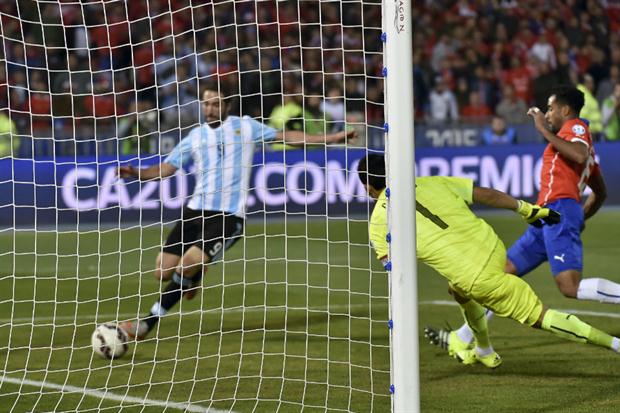
It was this aspect that prompted Gerardo Martino to ultimately turn to Gonzalo Higuaín instead of perhaps Carlos Tevez when taking off Agüero in the second half. Having seen the diminuitive Manchester City striker struggle to hold the ball up amid the physical approach of Gary Medel and his Chilean cohorts, Pipita was supposedly in place to play with his back to goal and bring others into the attack. With hindsight this proved costly, as Higuaín just lacked the pace to get on the end of Ezequiel Lavezzi’s last minute pass across the face of goal and after seeing that effort nestle in the side netting, the Napoli striker then blazed over from the spot in the shootout.
Just as he did for Napoli on the final day of the Serie A season with a Champions League spot at stake, Higuaín buckled under the pressure. Missing a penalty is not reason enough for a player to find their position under threat but since his glaring missing against Germany in Brazil, Higuaín has found his place questioned. Now might just be the time for Argentina to assess some of the alternatives.
During the regulation 90 and the extra-time period, Higuaín found himself as isolated as Agüero had before him and this leads to the earlier point about Argentina’s lack of goals. Prior to the goal-glut against Paraguay many had questioned why Argentina had not scored more goals given the amount of possession they had enjoyed and chances created. Javier Mascherano pointed simply to bad luck and inspired goalkeeping and while Gerardo Martino agreed with him, he did also admit that his side needed to get more people in the penalty area. This was no more evident than in the final and on the rare occasion that Javier Pastore did advance that far forward and was joined by Ezequiel Lavezzi it arguably could have brought Argentina the lead.
So in spite of the attacking riches available, there is still a slight disconnect between the midfield and attack made visible against sides capable of denying the midfield time and space while posing enough of a threat to keep the full-backs pegged back.

Interestingly it was the much-maligned defence that actually performed rather well on the whole in Chile. Only Paraguay managed to score and that was in a bizarre opening match where Argentina were guilty of taking their foot off the gas and what surmounted to a consolation in the 6-1 drubbing. However, despite conceding just three goals in six games and keeping four clean sheets, question marks still remain.
In Nicolás Otamendi and Ezequiel Garay, Argentina appear to have found a decent central defensive pairing albeit one that lacks outright pace but further depth must be uncovered, particularly given Martín Demechelis’ international retirement. The main questions lie elsewhere: the full-backs have been a worry for a few years now and although Marcos Rojo has answered his critics on several occasions since, against Chile the Manchester United full-back was targeted and looked increasingly shaky.
The wider issue is that it is not a position where Argentina are blessed with a deep pool of players to draw from. Lucas Orbán, Cristian Ansaldi or from the younger group Jonathan Silva may prove to be options but there is not a standout replacement. On the opposite flank, Pablo Zabaleta is as reliable as ever but at 30 years of age, a long-term replacement on the right needs to found also.
Neither where culpable for any glaring error that cost Argentina in the Copa América final but they were also unable to contribute anything to the attack. Ideally both would provide width that the Argentine side does not naturally have and stretch the opposition defence but with both sitting back it gave Chile’s defence more numbers to neutralise the forwards.
The goalkeeping position is also one that continously comes under the microscope with Sergio Romero struggling to establish himself as a number one at club level. Although he has never let down Argentina the longer he is without regular football in Europe, the calls for young Gerónimo Rulli will get louder.

 golazo argentino