
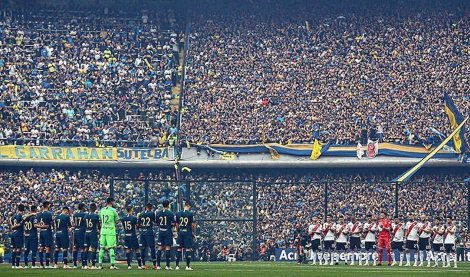
In light of Sunday’s dramatic Copa Libertadores first leg draw between Boca Juniors and River, Jack Tilghman looks at what makes the Superclásico just so bloody huge…
Quite often big matches underwhelm, especially in this age of social media and 24/7 media coverage. Almost no match can live up to the hype. Although this past World Cup Final between France and Croatia had plenty of drama and six goals, the previous two World Cup Finals did not see a goal until after the 110-minute mark. The last two Copa América Finals were scoreless even after extra-time and went to penalties but Sunday’s Copa Libertadores final first leg between Boca Juniors and River Plate at La Bombonera lived up, and then some.
River dominated the early stages, forcing Boca goalkeeper Agustín Rossi into a few very good saves before the Xeneizes took the lead through Ramón Ábila in their first real attack of the match. Just second later, River’s much maligned forward Lucas Pratto equalized, silencing the Bombonera crowd.
When Boca took the lead again through substitute Darío Benedetto, River was again able to bounce back and tie the match. Yet the highest drama was yet to come. In the 89th minute, club idol Carlos Tevez charged through the middle and squared the ball to Benedetto who saw his shot saved in sensational fashion – ‘The save of the championship,’ was what Boca radio announcer Daniel Mollo called it.
Even for the neutral watching from home with no connection to either team or Argentina could feel the passion through their screens and sense the meaning of the occasion. Nothing was manufactured about this Superclásico Final, everything was organic.
So what made this such a big deal?
The first answer is the sheer importance of football to Argentine society. Football is always in the discussion. Politics, entertainment, everything leads back to football. My mother often tells of her first day in school in 1965 when a girl asked every student who came in if they were a supporter of either River or Boca and the class was divided that way. 53 years later the rivalry is stronger than ever.
Another answer is that even though both Boca and River have nationwide and international followings, the rivalry stems from their birth together in the same Buenos Aires neighbourhood.
River moved out to the posh area of Recoleta then on to the leafy suburb of Nuñez, while Boca has never moved. For a derby match to truly be a derby, the clubs have to be from the same city. You need to go to work or school on Monday morning and hear it if your team loses. Sure, there are Barcelona fans in Madrid, but the true derby of that city is Atlético vs. Real.
The sense of history and the knowledgable fans is another reason. Every River fan knows the story of Norberto Beto Alonso and his goals against Boca in 1986, famously scored with an orange ball brought by Boca goalkeeper Hugo Gatti.

 golazo argentino