
Jimmy Lee
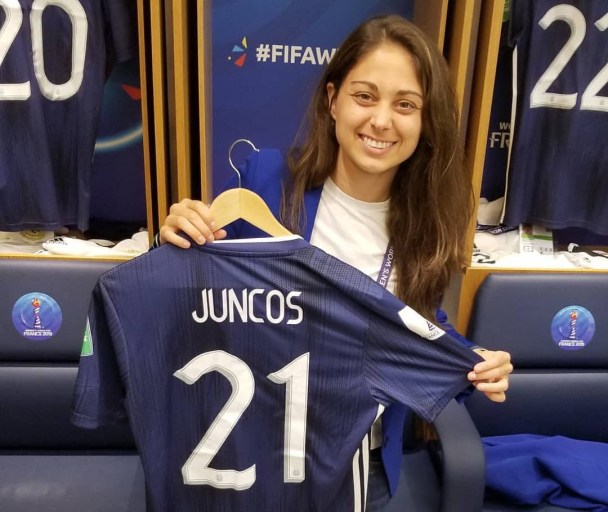
Argentine women’s football isn’t exactly easy to find on TV in Argentina. So you can imagine how much more difficult it was for me to watch living in the United States. Other than reading the names of the girls on the list of players who would be traveling to France for the World Cup, I didn’t know much about any of their backgrounds. As I started to learn more about the squad, one of the girls stood out above the rest – Natalie Juncos.
Natalie was born in the United States, to Argentine parents, both of whom represented their country as swimmers in the Olympics. I too was also born in the United States but lived in Argentina for a few years when I was younger. Having this in common with Natalie got me excited to learn more about her and her experiences living a split life between the two countries. On July 23, I got the chance to speak with her just hours before the team boarded the plane to Lima for the Pan American games.
Natalie was born in Michigan. Her father was beginning his career as a Physician, which moved their family to Minnesota when she was just five-years old. Natalie and her younger brother Nico lived the typical American childhood, with a few differences because her parents continued to carry on several Argentine traditions. The most memorable for Natalie were the Sunday asados and watching the Argentina national team on TV. She also traveled to Argentina each year to visit her relatives – the Juncos family in Córdoba and the Aracil family in Mar del Plata.
Her parents spoke both English and Spanish in the home, which allowed Natalie to be fluent in both languages from a young age.
“At night, one day my mom would read in Spanish to us and then the next night in English.”
But when Natalie was eight or nine years old, she was diagnosed with dyslexia. Her parents decided that if they wanted to help her overcome her challenges with reading, they would need to stop speaking Spanish in the home and devout 100% of their time to speaking English. As Natalie grew, she could always understand Spanish, but speaking it would become a challenge. In addition, in Spanish classes at school she stood out because she spoke Argentine Castellano and not the more traditional Spanish that was being taught.
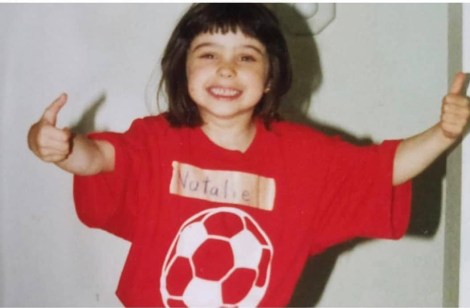
Even though Natalie struggled at times with Spanish, she still felt Argentine. She recalls once telling her mom on their way to school in the morning that she was indeed Argentine. Her mom told her, “No Natalie, you are very American.”
She persisted in telling her mom that she was Argentine. “So in the car, she was gonna drop me off at school and my mom said, ‘oh perfect Natalie, get off quickly before people start coming.’ I told her that I had to wait my turn to which she replied, ‘see, that’s why you’re not Argentine.’”
Natalie continued to play soccer for both her high school and club teams. This required her to drive nearly an hour and a half to Minneapolis / St. Paul four or five times a week. But at a critical time in her life, with just two years left in school, her parents told her that they would be moving from Minnesota to Brandon, Mississippi, a suburb just outside of the capital city Jackson.
Natalie was not exactly thrilled – “My parents made me. Imagine a teenager at 16 not wanting to leave. I was not very happy about that.” But moving to a new city nearly 1,000 miles away (1,600 kilometers) didn’t stop her from continuing to shine in soccer. She finished high school in 2008 as the captain of her team and accepted an offer to play for the University of Florida.
Florida had a big program with enough girls to fill three squads. Unfortunately for Natalie, she struggled to find her spot on the team and a year and a half later, decided to transfer to the University of Houston. “I learned a lot in Florida, I don’t regret the decision, but I decided I needed a change.”
As her playing time ramped up, so did her dream of representing Argentina’s national team. In 2010, with the help of her parents, she wrote a letter to manager Carlos Borrello, and asked him for a tryout with the squad. It took four years, but she finally completed the steps to qualify as a nationalized Argentine. After finishing her degree at Houston, she moved to Argentina to begin playing soccer in the country of her parents’ birth.
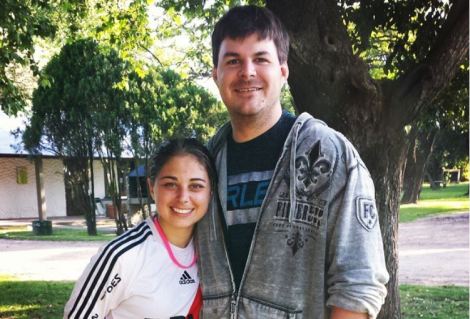
Even though she had traveled to Argentina every year of her life, living there full-time was a whole new adventure.
“I speak fluent [Spanish] but to this day I still struggle with the verbs and the articles, the masculine and feminine.” Because she is by blood Argentine, she can blend in as she travels around, but sometimes if she gets deeper into a conversation with someone, “they notice I’m from somewhere else and then I have to go and tell them my whole story. It’s a pretty constant thing.”
There is no question about it, Natalie stands out. She feels both 100% Argentine and 100% American – which can be confusing for any person who is trying to figure out where they fit in this world. But just as good mothers always seem to do, Natalie’s mom gave her the perfect advice – “Embrace who you are.”
Living a life split between two countries has been hard for her at times, but her mom always reminds her, “Don’t change who you are, adapt to situations of course, but accept who you are.” When Natalie first arrived, she was much more self-conscious of her Spanish, but carrying the advice of her mom in her back pocket, her confidence has grown and she has been able to accept that, “no matter where I go, there will be something that I am different in.”
Part of gaining that confidence was learning how to laugh at the mistakes she made. “The first year I lived in Argentina in 2014 I wanted to buy a hat, but I can’t roll my R’s and the guy I was buying it from was overweight, so when I asked for a hat ‘gorra’ it came out as ‘gordo’. I’ve definitely had a lot of those moments.”
But it wasn’t just the language that she had to learn to adapt to, even though she visited Argentina her whole life, living in the country presented new challenges. “When I’m here in Argentina, I miss my husband, my brother, my parents. I miss the little things of just being able to get in my car and go and not having to wait on a colectivo [bus] or a taxi. But that’s also a positive thing about being in Argentina, that every day is a different day – at the end of the day it’s always entertaining.”
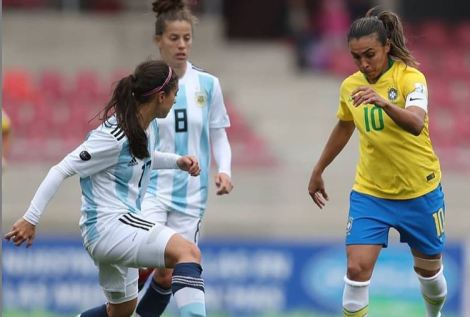
As the 2018 Copa America rolled around, Natalie was beginning to find her place with the team. She started all but one of the matches in Chile. Argentina finished third – good enough for a home and home playoff against Panama. Argentina would go on to beat Panama 5-1 on aggregate and earn their first birth in 12 years to the World Cup. But before those matches, Natalie’s career hit a significant speed bump.
Her first day back training with the national team in August, while trying to send in a cross, she stepped onto the ball and hyperextended her knee and tore her ACL. With just 10 months to go before the World Cup she knew it would be a tight window to recover in time. But having already conquered two different countries, Natalie was never going to let an injury slow her down. Day after day she worked with a singular focus – France 2019. After just seven months, her doctors in the United States gave her the thumbs up to start playing again.
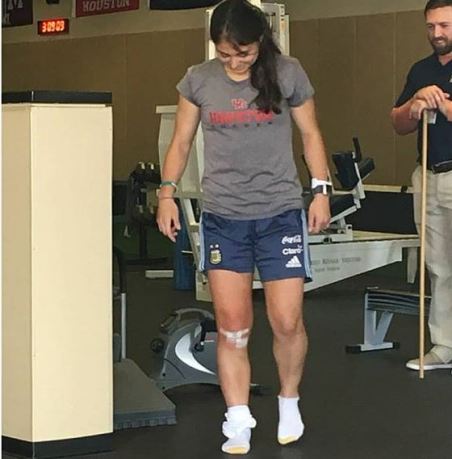
But of course, whenever things appear to be going well, life always finds a way to throw something else into your path. And so it was with Natalie. First, she had some shin issues that made it hard for her to jog. Then the doctors in Argentina refused to clear her until she was nine months out from her injury. Knowing that Carlos Borello would be announcing the squad one month before the start of the World Cup, the timeline was extremely tight. “In the AFA, we have four or five doctors and physical therapists, so it got really complicated when I would see a physician one day and another the next day and they all had different opinions.” But finally, the AFA doctors all agreed that she could resume playing.
As the day came to announce the 23 girls who would travel to France, Natalie knew there was a chance she might not make the cut. “I knew it was going to be tight making the list, but on the other hand, I was confident and calm because I knew I had done everything I could within my powers.” Borello brought the group together to announce who would not be making the trip – he did not say Natalie’s name – she was going to France. She had just achieved one of her lifelong goals. She would have the chance to wear the Albiceleste jersey in a World Cup. Time to celebrate, right?
No. That’s not the kind of person Natalie is. “When I didn’t hear my name I was like, ok, great I did it, I got this far, now the next step is trying to play. I think if I only tried to get to the list, I don’t know if I would have made it. You have to try and reach above something more than you think you can get. Maybe you get there, maybe you don’t, but at least you know you tried.”
/s3.amazonaws.com/arc-wordpress-client-uploads/infobae-wp/wp-content/uploads/2019/05/22144147/Convocadas-Mundial-Femenino-Francia-20191.jpg)


 golazo argentino
Excellent article. Very insightful into her life. Hope she continues to have success.
Pingback: Fight for Everything: An Exclusive Interview with Argentina’s Vanesa Santana | golazo argentino·